Showing posts with label Mysterious Places. Show all posts

Wednesday, December 1, 2010

0

Mystery Pyramids in China

|
Early stories about the pyramids in China began right around the Second World War. A US Air Force pilot named James Gaussman reportedly saw a white-topped pyramid during a flight between China and India in 1945. Walter Hain, an author and science writer, reports in his homepages (see his article below) how Gaussman described his first sighting of the pyramid. "I banked to avoid a mountain and we came out over a level valley. Directly below was a gigantic white pyramid. It looked like something out of a fairy tale. It was encased in shimmering white. This could have been metal, or some sort of stone. It was pure white on all sides. The remarkable thing was the capstone, a huge piece of jewel-like material that could have been crystal. There was no way we could have landed, although we wanted to. We were struck by the immensity of the thing." The story was subsequently picked up by the New York Times, who ran a story about the pyramid on March 28, 1947. Colonel Maurice Sheahan, Far Eastern director of Trans World Airlines gave an interview saying he had seen a gigantic pyramid 40 miles southwest of Xian. Two days after the report, the same newspaper published a photo, which was later attributed to Gaussman.

The worlds largest pyramid is rumored to be in Qin Lin county in a 'forbidden zone' of China, estimated at nearly 1,000 ft high and made of impounded earth and clay, and holding vast tombs. The Chinese govt have long denied the existence of 100 or so pyramids though the increasing tourism to the Xian tombs area (the Terracotta Army) is threatening the secrecy with tourists climbing the 25-100m pyramids for themselves.


spoiler gambarspoiler gambar


The government has planted trees on them to disguise them too. After outright denying their existence, the government finally admitted to the existence to New Zealand author Bruce Cathie of some 'trapezoid tombs', however a fabled white pyramid 1000 ft high has only ever been seen by a few Westerners this century. Here is an excerpt from a book:

"I was searching for a pyramid which was said to have been, once, many millennia ago, multicolored, and to now be a dusty white. This was a pyramid which, legend has it, rises to the astonishing height of 1,000 feet - four-fifths the elevation of the Empire State Building. Not only was this extraordinary structure said to be the largest pyramid in the world (the Giant Pyramid of Egypt, by comparison, rises a mere 450 feet); but, in the valleys surrounding it, there were said to be dozens of other pyramids, some rising to an elevation almost as great.
Until recently, Chinese officials have rebuffed all questions about these pyramids and all requests to view them. And yet, over this century, a certain mythology has grown up around them. An American trader, stumbling upon these amazing structures in 1912, asked his Buddhist monk-guide about them. He was told that 5,000-year-old monastic documents not only contained information about these pyramids, but said the pyramids were extremely old when these records were made.
The trader, Fred Meyer Schroder, observed several smaller pyramids in the distance. He wrote in his travel diary that his first sight of the giant pyramid, along with its smaller cousins, rendered him almost speechless. "It was even more uncanny than if we had found it in the wilderness," he wrote. "But those [ pyra-mids) were to some extent exposed to the eyes of the world—but still totally unknown in the western world."
In the Far East in the spring of 1945, though Japanese troops were still fighting in China, the U.S. Army and its allies were well on their way to pushing the Japanese off the mainland. One day, U.S. Air Force Pilot James Gaussman was returning to Assam, in India, after having flown the ‘Burma Hump’-ferried supplies to Chungking, China, from India-when engine trouble forced him to descend temporarily to a low altitude over China. As he later wrote:
"I flew around a mountain and then we came to a valley. Directly below us was a gigantic white pyramid. It looked as if it were from a fairy tale. The pyramid was draped in shimmering white. It could have been metal, or some other form of stone. It was white on all sides. What was most curious about it was its capstone: a large piece of precious gem-like material. I was deeply moved by the colossal size of the thing."
When Gaussman arrived back in Assam, combat duties pushed the sighting from his mind. Photographs he had taken of the giant pyramid would not be published for another 45 years. Till then, even his report would be buried in the Secret Service files of the U.S. military
Two years later, in 1947, another U.S. aviator, Maurice Sheahan—this time flying over Shaanxi Province, not far from Xian-- caught sight of a giant pyramid in the misty landscape below and rapidly snapped pictures. This time, several U.S. newspapers, in-cluding the New York Times for March 28, 1947, published accounts of the airman’s sighting. But Chinese archaeologists con-tinued to deny the existence of such a structure, even though Sheahan’s photographs suggested it was higher than any pyramid in Egypt. "
Today, with help of satellite images, we can be certain beyond any doubt that pyramids in China are real (and man-made).

Pyramid near the City Xian, on 34.22 North and 108.41 East.


spoiler gambar


New evidences 2009
The "White Pyramid" discovered! It is the Maoling Mausoleum!
Original article from October 25, 2006 revised in Feb 2009

Since many years already in the popular scientific community and in publications there are many announcements and contentions of gigantic pyramids in China. The puzzle around the look-up seems final after new discoveries. With the help of Google Earth, the objects are to be seen impressively. It can not be maintained longer, there might be no pyramids in China.! They have four sides and they are even square like the pyramids in Egypt and in Mexico. Its size can quite be matched with those of the Pharaons and of the Mexican rulers.

Already in 1912 of the two travel agents Fred Meyer Schroder and Oscar Maman reported of a tremendous building that they had seen in China."It was more eerie than if we had found them in the wilderness. Here they had been under the nose of the world, but unknown to the western countries... The big pyramid is about 1,000 feet high (other descriptions estimate 1,000 to 1,200 feet high) and roughly 1,500 feet at the base, which makes it twice as large as any pyramid in Egypt. The four faces of the structure are oriented with the compass points," the two travellers reported.

During the second world war, the pilot of the American Air Force, James Gaussman, with his co-pilot, flow - through a technical defect at his machine -, for several times over a specific territory in China. What he later reported sounds completely unbelievable:  
"I banked to avoid a mountain and we came out over a level valley. Directly below was a gigantic white pyramid. It looked like something out of a fairy tale. It was encased in shimmering white. This could have been metal, or some sort of stone. It was pure white on all sides. The remarkable thing was the capstone, a huge piece of jewel-like material that could have been crystal. There was no way we could have landed, although we wanted to. We were struck by the immensity of the thing", the pilots reported.

On March 28, 1947 the "New York Times" reported about that discovery. In an interview with the newspaper, the former far east director of the Transworld Airlines, Maurice Sheahan, says he has seen 40 miles southwest of Xian a gigantic pyramid."I was impressed by its perfect pyramidal form and its great size," says Sheahan.
Later, on March 30, 1947 the "New York Sunday Times" take over the report and published at the first the photo, which is actually made in 1945 by Gaussman, and that was soon forgotten.

In 1978 the New Zealand researcher Bruce L. Cathie bothered itself of a clarification of the puzzle. According to some correspondence with the Chinese embassy and the US air force he kept up the photo of 1947. He published the picture later in the first edition of his book "The Bridge to Infinity" of 1983. According to the photograph and the reports, the New Zealand researcher estimate that the pyramid must have at their basis a length of 450 meters (1500 feet) and a height of about 300 meters (1000 feet). It is a pyramid with four flat trapezoid shaped sides, a square plateau on the top and a square base, like the pyramids in Egypt and in Mexico. Such pyramids were up to now unknown to the experts in the western world and its existence was always denied: "There are no pyramids in China! Only pagodas - temple liked, peaked buildings", so the opinion of the world experts.


A comparison of a former satellite image of a pyramid in Shaanxi with the photo of 1947 found in the homepage of earthquest.co.uk of November 2001.


spoiler gambarspoiler gambar


I came to the "white pyramid" when I already read reports in specialized books before and then I saw the appropriate photograph in the book "The Face on Mars" of 1989 from the two Australian authors Brian Crowley and James J. Hurtak. Brian Crowley then sent a copy of the image in his book to me and then I passed it to Peter Krassa - a Austrian book author and China researcher. Later I published it in my German book "Das Marsgesicht" (The Face on Mars) of 1995.

I have left indeed Peter Krassa the photograph, but I wanted to however make and therefore prove attentive, that there are in fact pyramids in China. At the German edition "Ancient Skies", the journal of the "Ancient Astronaut Society", no. 6, 1991, I published a short report. One did not want to however publish the photograph of 1947. Gene Phillips, the founder of the mentioned society, has refused a report from me in the American journal of the Society - with the reason, the photograph could be "something doctored", somehow falsified. He considered the photograph for a forgery.

However, I was some extent amazed when I saw a German book in a bookshop in Hamburg, Germany - during a lecture trip - with the title "Die weisse Pyramide" (The white pyramid), written by Hartwig Hausdorf, he was until then completely unknown to me. The book appeared in 1994 and then I found out that Peter Krassa had made the photograph available to him - without my knowledge. However, Hartwig Hausdorf mentioned me in his book so the case is functional. Hartwig Hausdorf was very much strove anyway - and that was also my aim - for the thing and he has undertaken several China trips, around the report to go onto the basis. He found several pyramid mountains in China in fact and he has also published photographs from that. These were the first real evidence that there are pyramidal buildings in China exist. The "white pyramid" could constitute Hausdorf nonetheless not.

Bruce L. Cathie announces many details in its book "The bridge to Infinity" over pyramids in China and especially over the "white pyramid" - so too precise coordinate information. They should be had found north of the contemporary city Sian (Xi´an), by the foot of the river Wei-ho - exact at 34.26 degrees of northern width and 108.52 degrees of eastern length. This data were for me very helpful when I searched in September 2006, with "Google Earth" over China after the pyramids. This program was in the last years set up extended from Google into the Internet and one can recognize phantastic details of the Earth's surface, by means of satellite consumption - as e.g. too the mysterious lines in the plain of Nazca. The solution is not in all fields optimally, nevertheless mostly quite well.

According to some trouble I then kept up after the coordinate information of Bruce L. Cathie two pyramids. As result, I found further, more than twenty and bigger pyramids. They are square earth-pillars, constructed by Chinese craftsmen a long time ago very obviously. The professional world has therefore improper. There are indeed pyramids in China! Google Earth confirmed that again. The biggest one in this area is on 34.23 degrees North and 108.42 degrees East. The opinions diverge via the age of the pyramids. Some speak of 2500 to 3500 years. The legendary "Emperor of the prehistoric time" should at that time have been there.

The pyramids are in the province Shaanxi, north of the city Sian (Xi´an). On the satellite photographs of Google Earth, no "white pyramid" is to be recognized. Under the coordinates 34.26 degrees of North and 108.52 degrees East, two pyramids are visible, but however they are not identical to the photo from 1947. The pyramid lying a little southwest, in my opinion, comes onto 34.22 North most of all and 108.41 East, north of the small city Hsien-yang into consideration. An arrangement shows similar factors as on the photograph from 1947: A square plateau, grazes (excavations) on the sidewalls, similar ones walkways (streets) and in the background, a small settlement. But that pyramid is definitely not the "white pyramid".


The Maoling Mausoleum is the burial site of Emperor Wu Di.


spoiler gambar

In some Internet pages (Chris Maier) and in the homepage of wikipedia, the Maoling mausoleum is compared with the "white pyramid". And that is in actual fact correct. Already on former satellite images which were published in the homepage of earthquest.co.uk of November 2001, that is to be recognized. With Google Earth, this pyramid - although at present another with bad resolution - is it to be seen also. They lies west of the pyramids of Hsien-yang, close to the city Xianyang, on 30.20 degrees North and 108.34 degrees East.

The "white pyramid" needs not to be a tremendous mystic building. The pilots and the travel agents to see the Maoling mausoleum, with his size - according to the measurements via Google Earth - of about 222 to 217 meters on the ground and his height of about 46 meters, can quite have appeared below glistening sunlight glimmering and quite big. No other pyramid in this area is so big. Only the one on 34.23 North and 108.42 East, which has a size of 219 to 230 meters on the ground. The well known Shi Huang-ti Mausoleum, situated 50 kilometers East, has a size of 357 to 354 meters on the base and the whole complex has a size of 488 to 581 meters. But that grave mountain is actually a square mound and not a pyramid. Attainable is the area near Hsien-yang over the city Xi´an (Sian) obvious the airport that Hartwig Hausdorf with some traveling companions already used in 1994. They could for instance constitute seventeen pyramids within a radius of about three kilometers and they estimated its heights at sixty to seventy meters.

Comparison of the Gizeh pyramid complex (top image) with a pyramid complex in Shaanxi (bottom image)..


spoiler gambarThis new 3d image of the Maoling Mausoleum
shows the same characteristics as the image of 1947.
spoiler gambarNEW!!! This pyramid, of February 2009 by Google Earth, shows again the wellknown Maoling Mausoleum but in a better solution from GeoEye. The comparison above shows that is indeed the "white pyramid".

By the new aperture of China to the west, the corresponding investigations too would be able to be made amenable now at last for experts from other countries. For the better sense of China and of its past.

Comparison of the Gizeh pyramid complex (top image) with a pyramid complex in Shaanxi (bottom image)..


spoiler gambarspoiler gambar


source of various books
Read more »

Thursday, November 25, 2010

0

Mystery of Borobudur Temple

|
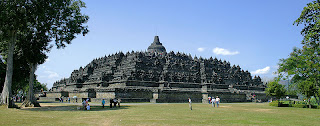
Corner Mystery - Borobudur a Buddhist stupa in the Mahayana tradition is the largest Buddhist monument in the world. This Buddhist monument from the eighth century (between 750 and 850 AD) has gained a place on Unesco’s world heritage list. Located 40 km (25 mile) northwest of Yogyakarta, Central Java, Indonesia, near the Mount Merapi (one of the most active volcano in Indonesia). It was built from nearly two million stone blocks of andesite, a bluish-gray volcanic stone, Borobudur is shaped like a stepped pyramid, the base of which is 402 feet long from north to south and 383 feet long from east to west; the height is now 95 feet above ground level. This magnificent temple is a three-dimensional diagram of the universe and a visual representation of Buddhist teachings. From above, the design of Borobudur resembles a mandala (a Hindu pattern used in meditation), leading to specu­lation that the complex was built by Indian Buddhists who were influenced by Hindu beliefs. Viewed from the ground, the mandala comes together to form a mountain of stone. For centuries, Borobodur lay hidden under layers of volcanic ash. The reasons behind the desertion of this magnificent monument still remain a mystery and no one knows what happened to the culture that built the monument.

Perhaps Mount Merapi had erupted, choking the rice lands with layers of volcanic ash. Whatever the cause, the population moved to East Java in a mass exodus, and Borobudur was left behind, its meaning lost in time. Some scholars believe that famine caused by an eruption of Mount Merapi forced the inhabitants of Central Java to leave their lands behind in search of a new place to live. When people once again inhabited this area, the glory of Borobudur was buried by ash from Mount Merapi.


Northwest View of Borobudur


spoiler gambar


Mountain peaks, according to Buddhist thought, are the place where contact with divine truth may take place. Pilgrims today and yesterday would climb Borobudur level by level, drawing closer and closer to complete infusion by divine wisdom. Essentially, the pilgrim can experience nirvana on earth. Borobudur has the mound shape of a stupa, the most typical Buddhist structure honouring Buddha. It is made of square and round terraces, topped by a dome-like structure.

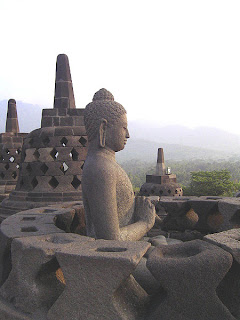
One of The Damaged Stupa with Buddha Statue Inside It


spoiler gambar


The terraces symbolise the three levels of the Buddhists’ cosmological system: the world of desire, the world of form without desire and the world of formlessness. These layers also depict the three steps of spiritual growth towards salvation.

Borobudur was rediscovered in 1814 by Sir Thomas Stamford Raffles, the British governor of Indonesia who, during his visit in Semarang, now the capital city of Central Java, received a report indicating the discovery of a hill full of many carved stones. The hill was believed by the local inhabitants to be the site of an ancient monument called budur. Raffles then commissioned a team led by Cornelius to investigate the hill. He was responsible for the excavation of Borobudur at that time, speculated that Borobudur may have originally been a holy place of pilgrimage for believers of the Mahayana branch of Buddhism. Monks from the nearby monastery would have led pilgrims along the galleries, using the carved panels to illustrate the stories of their faith and the way of the Buddha as they circled their way to the top of the monument.

Lacking further historical information, Raffles was unable to determine the exact date of Borobudur's construction. But he knew that in the 13th and 14th centuries, Islam had replaced Buddhism as the island's religion, and he thought it unlikely that Borobudur would have been built since then. Also, ancient records showed that in the 10th century, the region around Borobudur had been mysteriously deserted, and all construction in central Java had stopped then. From the detailed carvings, Raffles concluded that Borobudur had been built sometime between the eighth and tenth centuries, during a period of relative peace in East Asia, after the nomadic and religious invasions had run out of steam.

It was in 1835 that the site was cleared. Some efforts were made to restore and preserve the colossal monument since then. Unfortunately, in 1896 the Dutch colonial government gave away eight containers of Borobudur stones, including reliefs, statues, stairs and gates, as presents for the King of Siam who was visiting Indonesia. A restoration program undertaken between 1973 and 1984 returned much of the complex to its former glory, and the site has since become a destination of Buddhist pilgrimage. On January 21, 1985 the temple suffered minor damage due to a bomb attack. In 1991, Borobudur was listed by UNESCO as a World Heritage Site. The colossal monument consists of six rectangular terraces topped by three concentric circular terraces.

Four of the terraces are galleries, each enclosed by a balustrade and an inner wall, open to the sky and carved with sculptures. At first sight, the square galleries are an overwhelming mass of images depicting the activities of gods and mortals carved in the dark volcanic stone along the wide processional paths. There are more than 1,300 narrative panels illustrating the life of Buddha and Buddhist texts, the largest and most complete collection of Buddhist reliefs in the world. Originally, there were over 500 statues of the Buddha, 432 seated in lotus position on the square terraces and 72 meditating inside the bell-shaped stupas on the top terraces. There are no elaborate carvings on these three upper levels.

Some scholars think that this massive monument is a gigantic textbook of Buddhism to help people to achieve enlightenment. To read this Buddhist textbook in stone requires a walk of more than two miles. The walls of the galleries are adorned with impressive reliefs illustrating the life of Buddha Shakyamuni and the principles of his teaching. Representing the existence of the universe, Borobudur perfectly reflects the Buddhist cosmology, which divides the universe into three intermingled separate levels. The three levels are Kamadhatu (world of desire), Ruphadatu (world of forms), and Arupadhatu (world of formlessness).

In 1885 J.W. Ijzerman Chairman, an archaeologists of the Archeological Society in Yogyakarta discovered a ‘hidden base’ that was located behind the exterior wall of the lowest terrace, it has been built around the monument with 160 stone reliefs, 157 of which were covered and just 3 visible. In 1890-91, the complete ‘hidden base’ was exposed, photographed and encased again. Why the reliefs were ever covered up remains a mystery. There are various theories circulating, varying from structural explanations (the cover plates created a stronger base for the stupa) to iconographic ones (the sight and significance of the pictures was not supposed to be visible to everyone).

It is thought that during construction Borobudur experienced a landfall that threatened the entire building. To prevent the whole monument from collapsing, the Kamadhatu level was closed and made into a new base that holds Borobudur steady. This discovery brings about renewed efforts to safeguard Borobudur from vandalism and natural threats. The hidden base of Borobudur was originally the first level, which contains the gallery of Kamadhatu level.


Mahakamavibhanga (Causes of Good Health); Relief 20 from the Hidden Base, East Side, South End


spoiler gambar


The content of these hidden reliefs is loosely based on a Sanskrit Buddhist text called the Mahakarmavibhangga ("Great Exposition of the Law of Karma"). Buddhism postulates that for every cause there is an effect. Those who undertake good actions generate good effects, while those who initiate wrongful actions generate bad effects. Although the person committing the act may not immediately realize the results generated by his or her actions, the karmic effect will eventually play out, if not in this life then in a future existence or reincarnation. The Sanskrit-based Mahayana edition of the "Great Exposition of the Law of Karma" has never been fully translated into English.

Mahakamavibhanga (Causes of Good Health); Relief 20 from the Hidden Base, East Side, South End


spoiler gambar


However, a few short quotations from the Mahakarmavigghanga in English are available from various sources. For example, the Buddha tells the young Brahmin Shuka that there are a total of eighteen benefits to be derived from the building a Tathagata Stupa. "What are these eighteen?

One will be born as the child of a great king
One will have a noble body
One will become beautiful and very attractive

One will have sharp sense faculties
One will be powerful and famous
One will have a great entourage of servants

One will become a leader of men

One will be a support to all

One will be renowned in the ten directions

One will be able to express oneself in words and verses extensively

One will receive offerings from men and gods

One will possess many riches

One will obtain the kingdom of a universal monarch

One will have long life

One's body will be like a collection of vajras

One's body will be endowed with the major marks and the minor signs (of a Buddha)
One will take rebirth in the three higher realms
One will swiftly attain complete nirvana


These eighteen points are the benefits of building a Tathagata Stupa." Elsewhere in the text the Buddha says the following:

"If in this life you often use harsh speech to irritate others, and if you delight in exposing their private matters, and if you are stubborn and unyielding, then in your next life you will be born as a fire-spewing hungry ghost." We may derive additional information concerning the contents of this text by examining the version of the Mahakarmavibhangga that appears in the Pali Canon of Theravada Buddhism. In the Pali version of the text, the Sakyamuni presents a discourse in which he describes various human actions and their corresponding results. He begins by listing the ten wrongful actions of the evil-doer: killing living beings, stealing, engaging in sexual misconduct, speaking falsely, speaking maliciously, speaking harshly, engaging in gossip, coveting that which belongs to others, harboring ill will toward others, and holding wrongful views. In addition, he delineates the ten rightful actions, which consist of abstention from committing the aforementioned ten wrongful activities.

According to the Buddha, the minds of individuals are complex, generating a variety of karmic results within a single lifetime. The result of any karmic action may not even be realized during the same existence in which the act has been committed. Moreover, it is incorrect to presume that the evildoer always goes to hell, or that the good man always goes to heaven. Instead, the Buddha lists four possible outcomes concerning the evildoer who goes to hell, the evil doer who goes to heaven, the good man who goes to heaven, and the good man who goes to hell. It is entirely possible, said the Buddha, that any good actions that a person commits just before death could result in an evildoer going straight to heaven. Or the evil actions of a person committed just before death could cause someone whom had previously performed numerous acts of merit to go straight to hell upon the dissolution of the body. However, neither heaven nor hell is to be regarded as a permanent condition.

Each individual will eventually be reborn into future existences where the karma they have generated during previous lives will inevitably exert its effect. The main theme of these hidden reliefs is reward and retribution. Besides pictures of heaven and hell, there are scenes from daily life, worldly successes and dramas, good and bad things that are interconnected with deeds from the past and that determine whether reward or retribution is awaiting a person in the future. At the same time, the reliefs present a picture of day-to-day life on Java at the end of the eight and ninth century.

There is a scene for example in which there are monks shown on the right, receiving donations of food and drink (good deed); at the left of the same relief one sees how those who donated the food and drink are living a life of plenty, blessed with love, beauty and status – the reward. This level of Kamadhatu pictures the world of passion and the inevitable laws of karma. The first 117 panels show various actions leading to one and the same result, while the other remaining 43 panels demonstrate the many results that follow one single effect. At least 160 relief panels were carved around this level, based on the manuscript of Karmavibhangga. What is left of these can be seen in the Southeast corner of this level.

The next level is Rupadhatu level, it show the stories based on the manuscripts of Lalitavistara, Jataka-Avadana and Gandavyuha. The Lalitavistara reliefs, consisting of 120 panels, tell us about the life of Siddhartha Gautama Buddha. It starts with the glorious descent of Buddha from the Tushita heaven. Born as Prince Siddhartha, Buddha's childhood was isolated from the outside world's misery. Accidentally witnessing the misery of sickness, decrepitude and death, young Prince Siddharta decided to escape from the worldly life and commencing his search of freedom from suffering. Siddhartha’s long and painful search finally led him to the highest level of enlightenment and made him Buddha, the Enlightened One. This story ends with Buddha’s sermon in the Deer Park near Benares.

The Jataka is a collection of stories about Buddha's previous reincarnation, chains and virtues. According to the Jataka, Buddha was born 504 times before being born as Prince Siddharta, taking on the forms of god, kings, princes, learned men, thieves, slaves, and a gambler. Many times he was born in the forms of animals such as lion, deer, monkey, swan, big turtle, quail, horse, bird and many others. But the Boddhisatva (Buddha-to-be) was distinguished from all other kings, slaves, or animals among whom he lived. The Boddhisatva is always superior and wiser than those around him.

As to the relief of Avadana, the main figure is not the Buddha himself. All the saintly deeds pictured in this part are attributed to other legendary characters. The stories are compiled in Dvijavadana (Glorious Heavenly Acts) and the Avadana Sataka (The Hundred Avadana). The first 20 frames in the lower series of stories on the first gallery depict the Sudhanakumaravana. The series of reliefs covering the wall of the second gallery is dedicated to Sudhana’s tireless wandering during his search for the highest wisdom. The story is continued on the walls and balustrades of the third and fourth galleries. Most of the 460 panels depict the scenes based on the Mahayana text Gandavyuha, while the concluding scenes are derived from the text of Badracari.

On the last three circular uppermost terraces or Arupadhatu level, consists of 72 stupas circle the huge main stupa that crowns the top of the temple. The circular form represents the eternity without beginning and without end, a superlative, tranquil, and pure state of the formless world. There are no reliefs on the three circular terraces. All but the largest central stupas on the upper levels contain a (more or less) life-sized statue of the Buddha kneeling, although many of these statues are missing or damaged.

There are also many alcoves along the lower levels which contain similar statues but many of these are missing or damaged as well. As a testament in stone Borobudur is remarkable, but even without its reli­gious implications the art of the carved reliefs would ensure it a high place among the world’s greatest monuments.
Read more »

0

The Bermuda Triangle

|


Corner Mystery - The Bermuda Triangle is a stretch of the Atlantic Ocean bordered by a line from Florida to the islands of Bermuda, to Puerto Rico and then back to Florida. It is one of the biggest mysteries of our time - that isn't really a mystery.

The term "Bermuda Triangle" was first used in an article written by Vincent H. Gaddis for Argosy magazine in 1964. In the article Gaddis claimed that in this strange sea a number of ships and planes had disappeared without explanation. Gaddis wasn't the first one to come to this conclusion, either. As early as 1952 George X. Sands, in a report in Fate magazine, noted what seemed like an unusually large number of strange accidents in that region.

In 1969 John Wallace Spencer wrote a book called Limbo of the Lost specifically about the triangle and, two years later, a feature documentary on the subject, The Devil's Triangle, was released. These, along with the bestseller The Bermuda Triangle, published in 1974, permanently registered the legend of the "Hoodoo Sea" within popular culture.

Several books suggested that the disappearances were due to an intelligent, technologically advanced race living in space or under the sea.

The only problem was that the mystery was more hype than reality. In 1975 a librarian at Arizona State University, named Larry Kusche, decided to investigate the claims made by these articles and books. What he found he published in his own book entitled The Bermuda Triangle Mystery-Solved. Kusche had carefully dug into records other writers had neglected. He found that many of the strange accidents were not so strange after all. Often a triangle writer had noted a ship or plane had disappeared in "calms seas" when the record showed a raging storm had been in progress. Others said ships had "mysteriously vanished" when their remains had actually been found and the cause of their sinking explained.

More significantly a check of Lloyd's of London's accident records by the editor of Fate in 1975 showed that the triangle was a no more dangerous part of the ocean than any other. U.S. Coast Guard records confirmed this and since that time no good arguments have ever been made to refute those statistics. So the Bermuda Triangle mystery disappeared, in the same way many of its supposed victims had vanished.

Even though the Bermuda Triangle isn't a true mystery, this region of the sea certainly has had its share of marine tragedy. Perhaps the best known one was the story of Flight 19. The tale of Flight 19 started on December 5th, 1945. Five Avenger torpedo bombers lifted into the air from the Navel Air Station at Fort Lauderdale, Florida, at 2:10 in the afternoon. It was a routine practice mission and the flight was composed of all students except for the Commander, a Lt. Charles Taylor.

The mission called for Taylor and his group of 13 men to fly due east 56 miles to Hens and Chicken Shoals to conduct practice bombing runs. When they had completed that objective, the flight plan called for them to fly an additional 67 miles east, then turn north for 73 miles and finally straight back to base, a distance of 120 miles. This course would take them on a triangular path over the sea.

About an hour and a half after the flight had left, a Lt. Robert Cox picked up a radio transmission from Taylor. Taylor indicated that his compasses were not working, but he believed himself to be somewhere over the Florida Keys (the Keys are a long chain of islands south of the Florida mainland). Cox urged him to fly north, toward Miami, if Taylor was sure the flight was over the Keys.

Planes today have a number of ways that they can check their current position including listening to a set of GPS (Global Positioning Satellites) in orbit around the Earth. It is almost impossible for a pilot to get lost if he has the right equipment and uses it properly. In 1945, though, planes flying over water had to depend on knowing their starting point, how long and fast they had flown, and in what direction. If a pilot made a mistake with any of these figures, he was lost. Over the ocean there were no landmarks to set him right.

Apparently Taylor had become confused at some point in the flight. He was an experienced pilot, but hadn't spent a lot of time flying east toward the Bahamas which was where he was going on that day. For some reason Taylor apparently thought the flight had started out in the wrong direction and had headed south toward the Keys, instead of east. This thought was to color his decisions throughout the rest of the flight with deadly results.

The more Taylor took his flight north to try to get out of the Keys, the further out to sea the Avengers actually traveled. As time went on, snatches of transmissions were picked up on the mainland indicating the other Flight 19 pilots were trying to get Taylor to change course. "If we would just fly west," one student told another, "we would get home." He was right.

By 4:45 P.M. it was obvious to the people on the ground that Taylor was hopelessly lost. He was urged to turn control of the flight over to one of his students, but apparently he didn't. As it grew dark, communications deteriorated. From the few words that did get through it was apparent Taylor was still flying north and east, the wrong directions.

At 5:50 P.M. the ComGulf Sea Frontier Evaluation Center managed get a fix on Flight 19's weakening signals. It was apparently east of New Smyrna Beach, Florida. By then communications were so poor that this information could not be passed to the lost planes.

At 6:20 a Dumbo Flying Boat was dispatched to try and find Flight 19 and guide it back. Within the hour two more planes, Martin Mariners, joined the search. Hope was rapidly fading for Flight 19 by then. The weather was getting rough and the Avengers were very low on fuel.
The two Martin Mariners were supposed to rendezvous at the search zone. The second one, designated Training 49, never showed up.

The last transmission from Flight 19 was heard at 7:04 P.M. Planes searched the area through the night and the next day. There was no sign of the Avengers.

Nor did the authorities really expect to find much. The Avengers, crashing when their fuel was exhausted, would have been sent to the bottom in seconds by the 50 foot waves of the storm. As one of Taylor's colleagues noted, "...they didn't call those planes 'Iron Birds' for nothing. They weighed 14,000 pounds empty. So when they ditched, they went down pretty fast."

What happened to the missing Martin Mariner? Well, the crew of the SS Gaines Mill observed an explosion over the water shortly after the Mariner had taken off. They headed toward the site and there they saw what looked like oil and airplane debris floating on the surface. None of it was recovered because of the bad weather, but there seems little doubt this was the remains of the Mariner. The plane had a reputation as being a "flying bomb" which would burst into flame from even a single, small spark. Speculation is that one of 22 men on board, unaware that the unpressurized cabin contained gas fumes, lit a cigarette, causing the explosion.

So how did this tragedy turn into a Bermuda Triangle mystery? The Navy's original investigation concluded the accident had been caused by Taylor's confusion. Taylor's mother refused to accept that and finally got the Navy to change the report to read that the disaster was for "causes or reasons unknown." This may have spared the woman's feelings, but blurred the actual facts. The saga of Flight 19 is probably the most repeated story about the Bermuda Triangle. The planes, and their pilots, even found their way into the science fiction film classic, Close Encounters of the Third Kind.

Where is Flight 19 now? Well, in 1991 five Avengers were found in 600 feet of water off the coast of Florida by the salvage ship Deep Sea. Examination of the planes showed that they were not Flight 19, however, so the final resting place of the planes,and their crews is still the Bermuda Triangle's secret.
Read more »

Copyright © 2010 Corner Mystery

Template N2y Shadow By Nano Yulianto